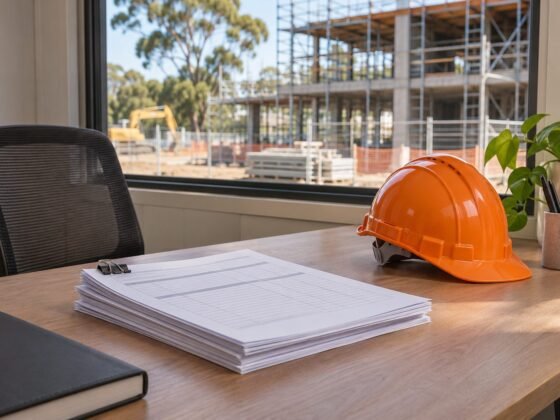




Commercial management helps builders win profitable work and keep it profitable, from estimating and contracts through to cash flow and the final account.
What commercial management covers
Commercial management construction work is everything on the money side of a building business. For a builder it runs from tender estimating and contract review through subcontract buying, claims, cash flow and the final account. It is the discipline that makes sure the margin you priced at tender is still there when the job is handed over.
The commercial manager is the builder’s own quantity surveyor, watching the numbers while the site team builds. Good commercial management does not slow a project down. It keeps the project honest and the builder solvent.
Reviewing the documents before you sign
The clauses that cost money are usually in the tender and contract documents before a brick is laid. We review those documents before signing, looking for the risk that is hidden in plain sight: liquidated damages, ambiguous scope, onerous variations clauses, retention rules and payment timing.
Signing a contract without reading these clauses is how good builders lose money on good jobs. A thorough review takes a fraction of the time the job will run, and it can save multiples of its cost the first time a clause is tested. Where a clause is unclear or one-sided, it is far cheaper to raise it before signing than to argue about it after.
Value engineering during delivery
Value engineering is often confused with cost cutting, but the two are different. Value engineering saves cost without losing function, while cost cutting simply removes scope and value. During delivery we look for the substitutions that deliver the same performance for less: a different material, a simpler detail, a more efficient sequence.
Done early, value engineering is a genuine saving. Done badly, it strips out the things the client actually needs and stores up a dispute. The test is always whether the client gets what the building needs, not just whether the line item got cheaper.
Cash flow and the monthly claim cycle
Cash flow is the builder’s heartbeat, and it runs on the monthly claim cycle. The work done each month must be measured, claimed, certified and paid without gaps. A claim that is late, incomplete or badly substantiated slows the whole cycle and starves the site of cash.
We keep the cycle tight. The claim goes in on time, is fully measured and backed by records, and any deduction is challenged the same month rather than left to fester. A steady claim cycle is worth more to a builder than a clever tax structure, because it keeps the job funded week to week.
When to bring in an external commercial manager
Many builders manage their own commercial work until a job gets large or complex, and that is usually the right time to bring in an external commercial manager or a placement. A large project, a difficult contract, a stretched site team or a run of contested claims all signal that the money side needs a dedicated pair of hands.
The external commercial manager brings the same skills without the overhead of a permanent hire. They step in for a project or a period, tighten the estimating, the claims and the final account, and step out when the job is back on track.
Frequently asked questions
Is commercial management the same as project management?
No. Project management runs the programme and the site, while commercial management runs the money. They work side by side, but the skills are different.
Should a builder review a contract before signing it?
Always. The clauses that cost money are in the contract, and it is far cheaper to raise them before signing than to argue about them later.
Can value engineering be done after the contract is signed?
Yes, and it often is, but the earlier the better. Early changes are cheap, while late changes risk the programme and the client’s goodwill.