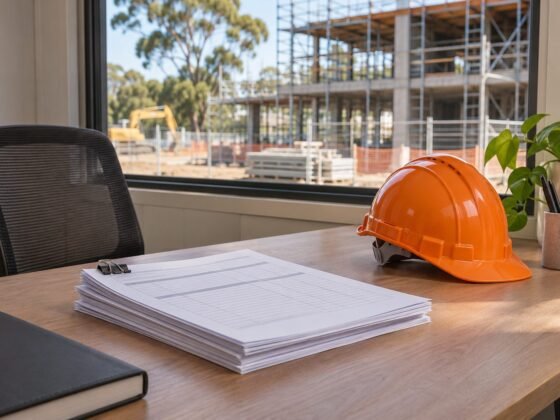




Construction claims management covers progress claims, variations and extensions of time, and this guide shows how to prepare and assess them properly.
What construction claims management covers
Construction claims management is the work of keeping money and time flowing fairly on a project. It covers the formal requests that keep a contract honest: progress claims, variations, extensions of time, and the prolongation and delay costs that follow when things slip. A quantity surveyor sits in the middle of most of these, measuring, pricing and recording so each claim can stand up to scrutiny.
The four main claim types work differently. A progress claim is the monthly or staged bill for work done to date. A variation claims the cost of a change to the scope. An extension of time claims more time for a delay that was not the builder’s fault. Prolongation and delay costs claim the money that delay costs in site overheads and lost productivity.
Preparing a claim that gets approved
A claim that gets approved is built on four questions, answered in order.
- Entitlement. Do you have a contractual right to the claim? Point to the clause.
- Notice. Did you give notice in the time and form the contract requires?
- Evidence. Do the records support what you say happened?
- Quantum. Can you measure and price the amount you are asking for?
We prepare claims by working through those four questions and building the paperwork behind each answer. Entitlement is the foundation. If you cannot point to a clause, the rest rarely matters, so we check the contract first and quote the clause that gives the right.
Assessing a claim made against you
The same four questions work in reverse when a claim lands on your desk. Ask entitlement first: does the claimant actually have the right they say they have? Then check notice, because a late notice can end the matter quickly. Then test the evidence, and finally re-measure the quantum to see if the amount is honest.
Assessing a claim is not about being difficult. It is about paying what is properly due and challenging what is not. A fair assessment protects the project as much as it protects your budget, because it stops weak claims from setting a precedent for the rest of the job.
The records that decide claims
Claims are usually won or lost on records, not on argument. The four records that matter most are site diaries, programme updates, photographs and correspondence. Diaries show what actually happened on any given day. Programme updates show when the delay occurred and who caused it. Photographs prove conditions on the ground. Correspondence shows what was said and when.
When these records are missing, a good claim becomes a hard one. We help clients keep the records from day one, because it is far easier to capture a fact at the time than to reconstruct it months later when the dispute has already started.
A worked example
A builder receives an instruction to add a new wall and an extra door to a fit-out. The superintendent directs the change in writing, so the builder has entitlement. The builder gives notice within the contract period and asks for the change to be priced as a variation.
We measure the wall and door from the drawings, price the labour, materials and fixings, and add the preliminaries and margin the contract allows. We attach the measurement, the rates and the superintendent’s direction. The superintendent checks the numbers, asks one question about a rate, and approves the variation the same week. The claim was approved because the entitlement, notice, evidence and quantum were all in place before the question was ever asked.
Frequently asked questions
Do I need to give notice before I price a variation?
Yes, and the notice rules come from your contract. Miss the notice and you can lose the right to claim, even if the work was clearly extra.
What is the difference between an extension of time and delay costs?
An extension of time gives you more time to finish, while delay costs claim the money that delay costs. You can have one without the other, so they are prepared and priced separately.
How long should I keep project records?
Keep diaries, photos and correspondence for the life of the project and beyond any final account. Records are your best protection, and it is much easier to keep them than to recreate them later.